Come Calcolare LDL Without a Calculator: A Step-by-Step Example
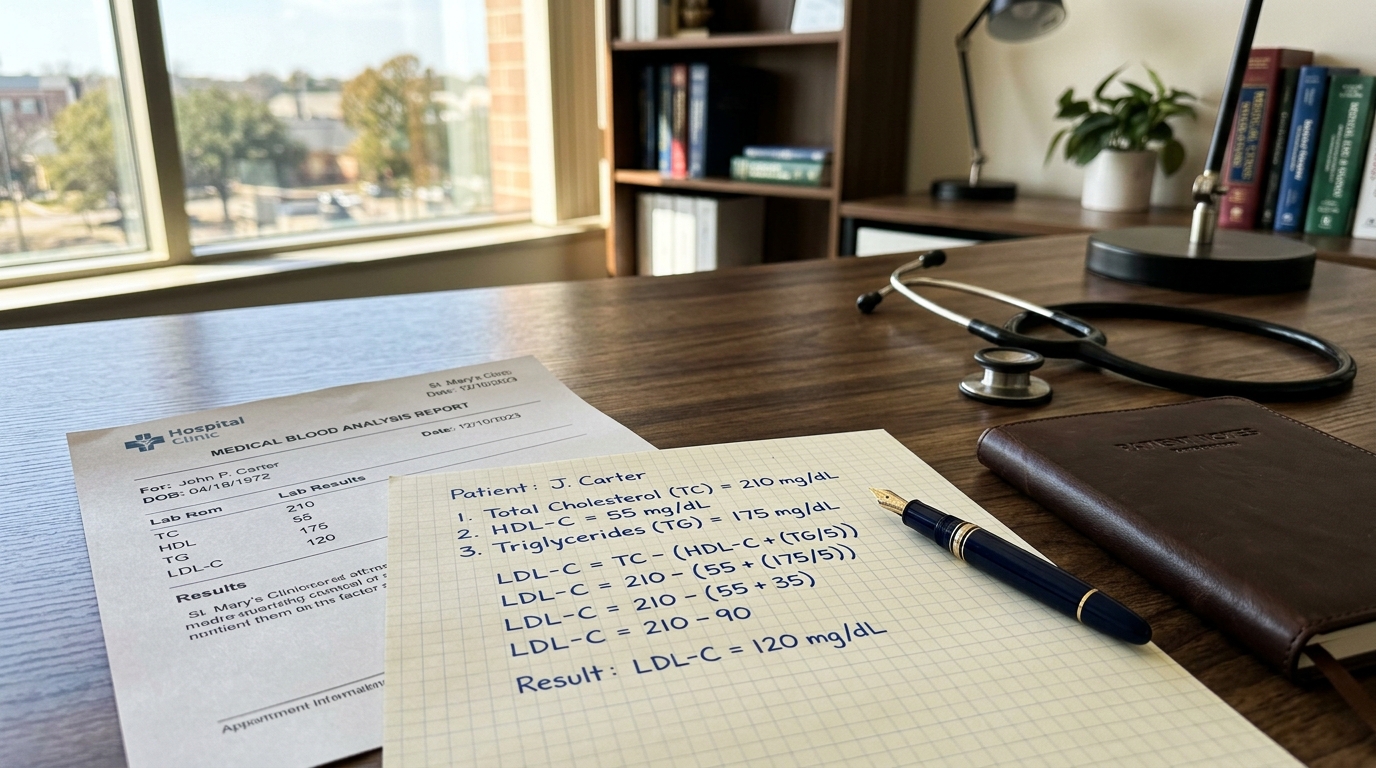
Staring at a lab report with no calculator nearby? Relax. Come calcolare LDL takes only three numbers and a bit of mental arithmetic. You do not need an app or a spreadsheet. A pen and the back of an envelope will do. This guide shows you the exact method with two worked examples. You will also learn quick checks that catch mistakes. By the end, you will handle the math with confidence. Ready? Let’s dive in.
Quali numeri servono per iniziare?
You need three values from your report. First, total cholesterol. Second, HDL cholesterol. Third, triglycerides. Most labs print them in one tidy block.
Next, check the unit beside each number. Most Italian and American reports use mg/dL. Some labs use mmol/L. The formula changes slightly between the two. Also confirm that you fasted before the draw. A recent meal can raise triglycerides and distort the estimate. Gather these details first and the rest feels effortless.
Come organizzare i dati del referto
Write the values on one line. For instance: total 200, HDL 50, triglycerides 150. Label each one. Clean notes prevent silly slips later.
Then compare units across all three numbers. Mixing mg/dL with mmol/L is the most common trap. The table below shows the key differences.
| Unit | Triglyceride divisor | Typical total cholesterol |
|---|---|---|
| mg/dL | 5 | 150–200 |
| mmol/L | 2.2 | 4.0–5.2 |
Keep this small cheat sheet nearby. It saves you from guessing mid-calculation.
Come applicare la formula LDL
The method is called the formula Friedewald. It runs in three moves. First, divide triglycerides by 5 to estimate VLDL. Second, subtract HDL from total cholesterol. Third, subtract the VLDL figure from that result.
In one line: LDL = total − HDL − (triglycerides ÷ 5). Think of it as peeling an onion. The total is the whole bulb. HDL and VLDL are the layers you remove. What remains is LDL. Simple, right? With mmol/L values, swap the 5 for 2.2.
Primo esempio con valori semplici
Let’s use friendly numbers. Total cholesterol is 200 mg/dL. HDL is 50. Triglycerides are 150.
Step one: 150 ÷ 5 equals 30. That is your VLDL. Step two: 200 − 50 equals 150. Step three: 150 − 30 equals 120. Your estimated LDL is 120 mg/dL. Write the answer down with its unit. That habit alone prevents confusion later. Notice that the whole job took under a minute. This is the essence of LDL calculation step by step.
Secondo esempio con valori differenti
Now try a trickier case. Total cholesterol is 240 mg/dL. HDL is 40. Triglycerides are 200.
Divide 200 by 5 and you get 40 for VLDL. Subtract HDL: 240 − 40 equals 200. Subtract VLDL: 200 − 40 equals 160. Your LDL is 160 mg/dL.
Here is a metric version. Total 5.2 mmol/L, HDL 1.3, triglycerides 1.1. Divide 1.1 by 2.2 and you get 0.5. Then 5.2 − 1.3 − 0.5 equals 3.4 mmol/L. Same logic, different divisor.
Come controllare il risultato
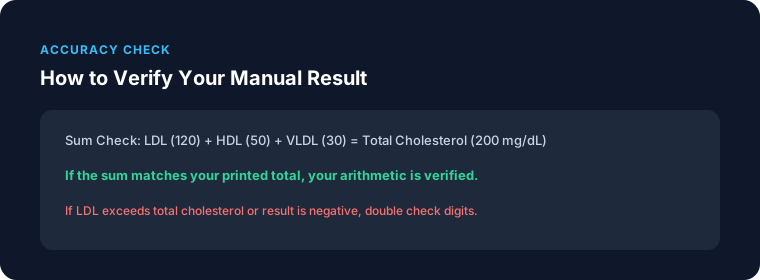
Always verify your answer. Add LDL, HDL, and VLDL together. The sum should return your total cholesterol.
Test the first example. 120 plus 50 plus 30 equals 200. It matches. Test the second. 160 plus 40 plus 40 equals 240. Perfect. If the sum misses, you made a slip somewhere. Go back and redo each subtraction slowly. Also ask whether the answer feels reasonable. An LDL larger than the total is impossible. Spotting that instantly saves embarrassment at the doctor’s office.
Come evitare errori matematici
Mistakes cluster in four places. First, people forget to divide triglycerides. Second, they use 5 for mmol/L values. Third, they subtract in the wrong order. Fourth, they ignore the formula’s limits.
That last point matters. When triglycerides reach 400 mg/dL or more, the formula becomes unreliable. The result can drift far from the truth. In that case, ask your lab for a direct measurement. Slow down and double-check. Writing every step on paper beats mental shortcuts. Accuracy always wins over speed.
Come fare il calcolo rapidamente
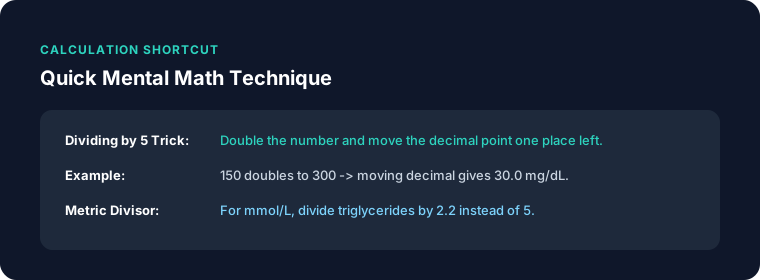
Want speed? Round triglycerides to the nearest ten. A value of 148 becomes 150. Divide by 5 and you get 30. Then subtract mentally.
Another trick: halve the number, then halve it again, then adjust. It sounds odd. Yet dividing by 5 equals multiplying by 2 and moving the decimal point. So 150 doubles to 300, which becomes 30. Practice twice and it sticks. Fast math gives you a ballpark figure at the doctor’s desk. However, use exact numbers whenever you record results for your files.
Quando è meglio utilizzare un calcolatore LDL
By-hand math shines for quick checks. Yet a digital tool wins in several situations. You may have many reports to compare. You may need to convert units. Or your triglycerides may sit near the formula’s limit.
Some tools use the newer Martin-Hopkins method. It adjusts the divisor to your own numbers. That produces better estimates when triglycerides run high. The National Institutes of Health describe cholesterol testing at nih.gov. Use calculators as helpers. Your lab report remains the official record.
Conclusione: calcolare LDL passo dopo passo
You now own a reliable method. Gather three numbers. Divide triglycerides. Subtract twice. Verify the sum. That is the whole routine.
Remember the examples: 120 mg/dL in the first and 160 mg/dL in the second. Practice with your own report tonight. Mastering come calcolare LDL removes the mystery from lab sheets. Moreover, it prepares you for sharper questions during your next appointment. Math you understand becomes health knowledge you can actually use.